Heavy Métl
Search Bar
Process

Harvest
Through decades of experience the Sanchez family have learned from generation-to-generation how to identify when the maguey are mature and are approaching the end of their life cycle. At the end of the plant’s life cycle, the maguey shoot up a quiote (flower stalk) that if left to grow and flower will rob the agave of nutrients and energy for the last stage of life which is reproduction and will in-turn render it useless for mezcal production. At this point the decision is made to either allow the agave to continue the reproductive cycle, and to be able to collect seed in approximately 9 months, or to stop the formation of the quiote by cutting it off, as it is developing thus leaving the agave capon. This process essentially castrates the plant and allows it to continue to live in the ground concentrating sugars, flavors and aromas. Ideally the agave will be left living in the ground for 6 months – 2 years (sometimes longer depending on the species) before harvesting it.
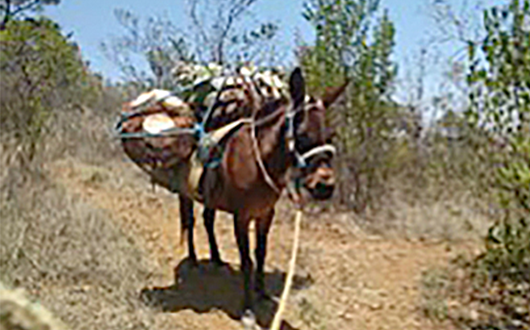
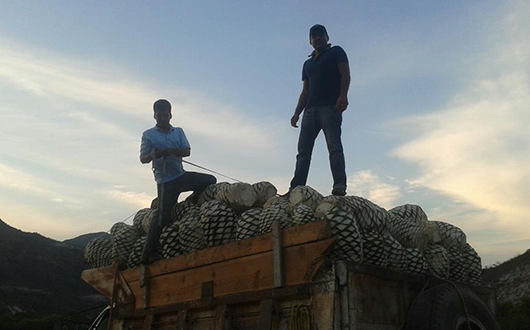
Once mature, the maestro selects the strong and healthy agaves that he believes will give him the desired flavors and aromas in the finished product. The selected agaves are then hand-harvested with machetes to strip them of their pencas (leaves) leaving only the piñas (hearts) which will then be taken back to the palenque to be transformed into mezcal.

Roasting
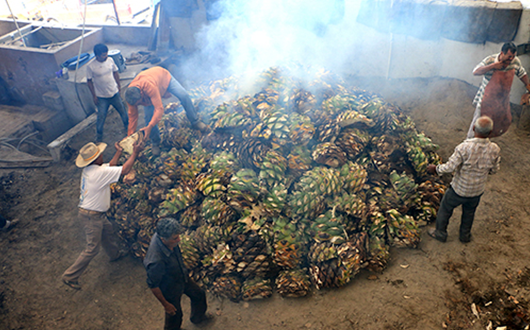
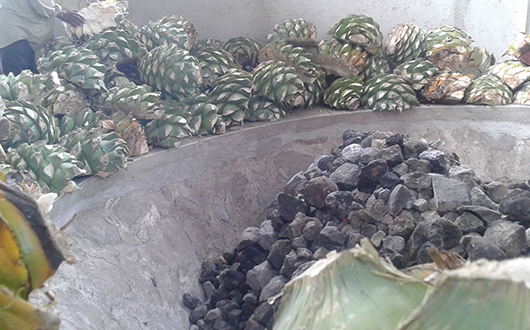
The cooking of the piñas begins with a small bonfire built in the Sanchez conical earthen oven from the wood of Mesquite and Encino (Oak) trees. After several hours when the fire has tempered down, they carefully place river rocks over the fire. The rocks are left for several hours until they burn red-hot and are then covered with moist bagazo or mash leftover from a previous distillation. This layering insulates the piñas from direct heat and keeps them from burning while being cooked. One by one the piñas are methodically placed on top of the bagazo and each other until the oven is filled with the available piñas or to capacity. The piñas are then carefully covered with burlap type sacks made from Ixtle (agave fiber) or petates (woven mats) ensuring there are no gaps between them. Once in place, the Ixtle sacks or petates are then covered with approximately 40 cubic feet of dirt meant to trap in the heat and moisture where the maguey are then left to roast for 4-5 days. The roasting time is determined by a variety of factors such as: the type(s) of agave being cooked, the quantity of agave and the internal temperature the conical earthen oven.
When the piñas are cooked to the maestro’s satisfaction and are deemed ready to be removed from the oven, the tedious task of removing the layers begins. First, as much soil as possible is removed from the top of the sacks. The sacks are then meticulously removed to ensure that none of the remaining soil falls onto the cooked piñas below.
Once unearthed, the piñas are left to rest in an area of the palenque with ample cross ventilation for up to a week prior to milling (depending on the species), so that they cool off and in the process are covered with wild yeast. This helps start the fermentation process.

Milling
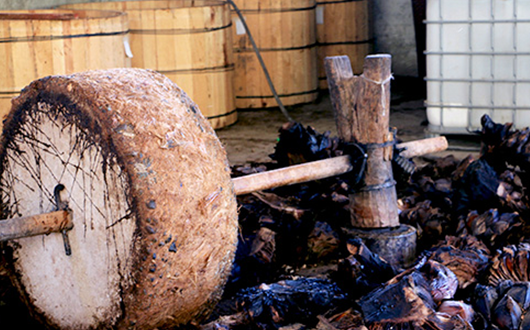
The piñas are then quartered into smaller pieces and milled into a pulp-like fermentable mash with a tahona or Chilean Mill, which is a giant stone wheel pulled by a mule.

Fermentation
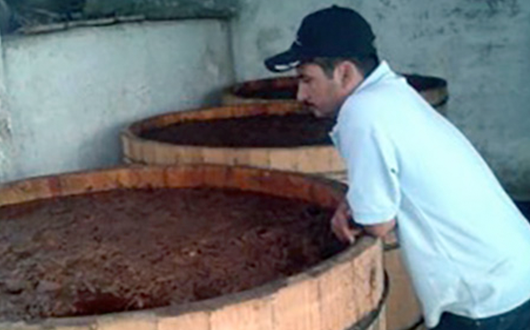
The resulting agave mash or mosto, as it is called, is loaded into pine vats where with a combination of wild and ambient yeast, it will open air ferment and consume the delicious sugars of the caramelized maguey and thus activate the fermentation process.
When the mosto is first loaded into the wooden vats it is left to sit for an average 2-3 days before adding water to aide in the fermentation process. Once the water has been added, there are approximately 7-10 days of active fermentation. This depends on the time of year (temperature), the agave(s) being fermented, the sugar content and lastly the maestro’s personal preference.
The ambient outside temperature greatly influences fermentation times. If the temperature is cool out the fermentation is slower. Conversely, if it is warm, then the fermentation process is quicker.
It is important to note that the sugar content of the agave or Brix is also a determining factor in fermentation times. The higher the Brix in the agave being fermented, the longer it takes the yeast to consume the sugars. The lower the Brix, the quicker the yeast completes its work. In either case once the sugars have been consumed the mosto is ready to be distilled.
Though a maestro may have learned from his father, and his father from his father, over time each develops their own personal preference as to how long to let each type of agave ferment under the aforementioned criteria. For instance, Romulo, who learned from his father Ramiro, prefers a shorter relatively fermentation time, whereas Ramiro likes to let his fermentation run a little longer. Mind you, the difference in fermentation time is not hugely significant and may only be 12-48 hours.

Distillation
Our mezcales are double distilled in hand-crafted copper stills produced in the village of Ocotlán de Morelos. Currently the Sanchez family use 250, 350 & 500-liter stills which are fueled by wood from Sauce trees and scraps from the lumber mill.
Maestro Romulo Sanchez is relentless in always trying to perfect the process or do things a little differently. As an example, in order to be able to work with Jabalí more efficiently he began to experiment with different still heads, still head heights and line arm angles to dial in the production of this difficult agave, in an attempt to make it less cumbersome. On a separate occasion, a few years ago he designed a unique clay pot still for micro- batch production of only two clay pot distilled mezcales, which was used for the highly coveted Espadin + Pulquero batch and a currently unreleased batch of Jabalí.


Resting in Glass
When a mezcal has passed laboratory, it is then transported from Yegole in bulk to the Sanchez’s offices in Oaxaca City. Once there the mezcal is then pumped into glass demijohns/ carboy where they will rest until ordered. The Sanchez believe that a mezcal gets better with time and will a minimum will leave the mezcal to rest for 3 months and some have rested for close to 40 months. There are a couple of them that have been resting for 5 years.

Blending to Perfection
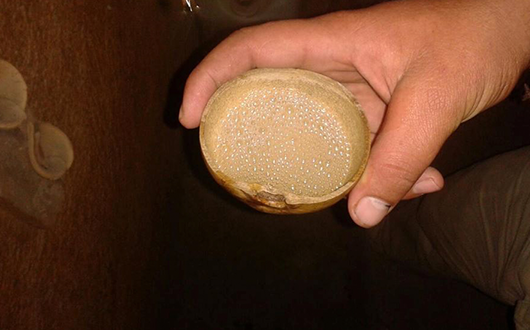
Rey Campero mezcales are blended to perfection for aroma and flavor by combining the heads, hearts tales (puntas, corazon y colas) and sometimes water to achieve the desired flavor profile that Maestro Mezcalero Romulo Sanchez seeks.
© 2026 Heavy MÉTl Premium imports, LLC. Website crafted with <3 in San Antonio, TX by GDG